

Preparing for BJJ Competition, Four-Part Framework
Jiu Jitsu is in its awkward teenage phase. One of Jiu Jitsu’s hallmarks of awkwardness is the way it approaches competition preparation.
Many schools and competitors remain stuck in a trial-by-fire paradigm to prepare competitors. While this approach may help cultivate some mental resilience (and even that’s debatable), it more often decreases preparedness, diminishes recovery, and increases injury risk.
Instead of clinging to its awkward phase, Jiu Jitsu needs to embrace the fundamentals of sports and exercise science to better prepare competitors for the arena. What follows is a simple, four-part framework for doing that.
Part 1: Know your why
Every performance conversation between coach and athlete should start with an exploration of the athlete’s motivations. Why have they chosen this specific goal — in this case, Jiu Jitsu competition?
Competition veterans and novices of all ages and ranks usually have a similar set of goals: to learn something about themselves, test their capabilities, improve their Jiu Jitsu, and (hopefully) bring home something more than the thanks-for-coming T-shirt. These goals are drastically different from winning a world championship.
Coach and athlete must arrive at this why before competition prep begins because it informs every training decision downstream. A world-champion competition camp looks drastically different from the novice’s or the weekend warrior’s. And confusing the two can have disastrous consequences for the athlete.
For masters-division competitors and rookies, that why often points toward refinement, not reinvention — which brings us to the mats.
Part 2: Game planning and skill editing
Game planning and skill editing are the Jiu Jitsu-specific aspects of competition prep. Game planning is establishing a collection of well-practiced tactics to accomplish your goail. What strategies and techniques will you use to achieve your desired outcome? It helps to be as specific as possible while holding onto those specifics loosely.
An example: You enter a competition planning to execute an uchimata from standing, pass to side control, and submit with a bread-cutter choke. But you also must be open to the possibility that your opponent is a skilled guard-puller. Consider your game as it is, then inventory its strengths while eliminating its vulnerabilities.
Skill editing comes next. Some coaches frame this as skill acquisition. In most cases, this is the incorrect framing.
Most athletes should focus on sharpening their A-game, not adding to it in the run-up to competition. This is not the time to be incorporating new tricks and trends. It’s the time to make absolutely lethal what you already do best.
Beginners often push back on this. What if I don’t have an A-game? What if I don’t know anything? Your emphasis in competition prep is fundamental Jiu Jitsu: Pinning positions, pin escapes, closed- and half-guard passing, submissions from these guards and pinning positions. And here’s a dirty little secret: In the amateur and masters divisions, these are the factors that will most often decide matches at all belt levels.
Chasing the latest trend guard likely will not help. Having sound principles will.
Part 3: Training schedule
Most amateur and masters athletes have neither the time nor energy to train like professionals. This makes competition success largely a matter of scheduling.
These athletes should be training no more than 5-6 days weekly with at least one day of complete rest (active recovery, such as an uptempo walk, is acceptable on this day). Of those 5-6 days:
- Devote 3-4 sessions to game planning and skill editing on the mats (emphasis on live rounds and positional training)
- 1-2 sessions to supplemental strength work
- 1-2 to metabolic conditioning sessions
Some days will combine categories, such as Jiu Jitsu and strength, or strength and metabolic work.
Overall, the goal for your training schedule is to push – not break – yourself. The commitment should feel difficult, just beyond your believed capabilities. Ultimately, sticking to that schedule and other matters of accountability are on you, not your coach. This builds the conviction that you have prepared well.
Part 4: Periodization
In strength and conditioning, periodization is how we plan training duration and intensity over time to optimize performance while minimizing injury risk. Historically, Jiu Jitsu is terrible at this. We should not be shark-tanking athletes the week of a competition, for example.
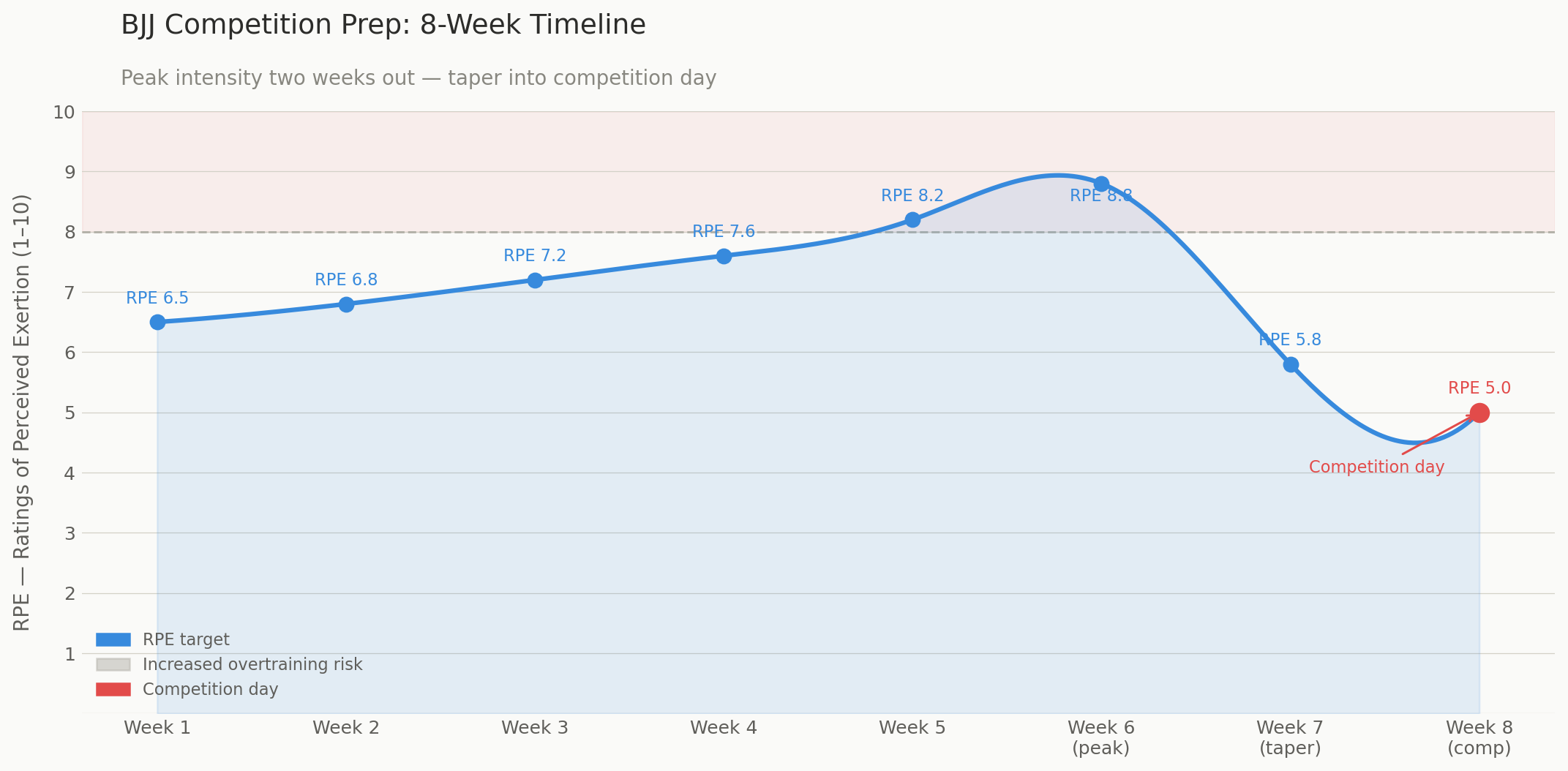
As a general rule, training intensity on and off the mats should peak about two weeks prior to competition day. The last week is for skill refinement, mental performance priming, and recovery. Mind and body must be sufficiently rested for competition day, particularly for competitions that will require multiple rounds of grappling.
I’ve entered nearly every competition of my 10 years in Jiu Jitsu overtrained, sick, and/or injured. This was and is largely my fault because like most grapplers, my default is to do more, push harder, dig deeper. These are essential ingredients for competitive success, but you can’t do more, push harder, or dig deeper if the well is already dry on the day of battle.
A better approach to periodization in this case is Ratings of Perceived Exertion (RPE). This is the athlete’s subjective view on how difficult their training is. A one is lying on a tropical beach, getting a massage. A 10 is everything you have, nothing left.
Most of the time, athletes should be hitting 6-8 in their RPEs. If you were to plot those RPEs on a timeline, they would take a wave form with the wave crest peaking at around 8 RPE two weeks before competition. Then the week of competition, RPEs are hovering below level 6 to refill the tank for game day.
The fundamentals done well
Like so many other aspects of Jiu Jitsu, effective competition prep is largely a matter of doing the basics well. It starts with understanding your goals, then laying the foundation to achieve them.
This does not look like running yourself into the ground. It looks like building yourself up methodically so you show up on competition day prepared physically and mentally. You arrive ready to appreciate the transformative power of competition, and hopefully go home with something more than a thanks-for-coming T-shirt.
Joe Hannan is a BJJ Black Belt and NASM-CPT.
Related Posts
-

Ode to Masters: What it Has Meant to Me
August 14, 2019 -
Should You Compete?
May 10, 2019 -
How to Bring the Best Version of Yourself to Competition
February 25, 2019


